LED Sports Lighting Energy Savings: How to Calculate the Full ROI
For many sports facilities, the lights come on before the players arrive.
Metal halide fixtures need time to reach full brightness, so switching them on early can become part of the daily routine. Repeated across a full season, that early start can add avoidable energy costs and make an already tight booking schedule harder to manage.
To understand what LED sports lighting energy savings could look like at your facility, you need to examine more than fixture wattage. Lighting coverage, controls, maintenance, and the value of any time you can realistically recover all belong in the calculation.
This guide will help you identify those costs and build a more complete ROI estimate for your facility.
Key Takeaways
- LED sports lighting energy savings depend on the existing and proposed system loads, actual operating hours and the facility’s electricity rates.
- Instant-on LEDs can remove metal halide warm-up time, but recovered time has rental value only if it can realistically be booked.
- A photometric plan helps assess whether a lower-wattage LED system will light the areas players need to see.
- A credible payback estimate includes project costs, maintenance savings, confirmed rebates and any realistic net operating value.
Why Metal Halide Sports Lights Need Time to Warm Up
If your facility still uses metal halide lights, evening programming may begin well before the first player steps onto the field or tee deck.
Staff switch the lights on early because metal halide lamps need time to reach full brightness. That routine can become so familiar that the extra operating time is simply accepted as part of opening the facility.
The U.S. Energy Information Administration describes one of the key differences between the two technologies:
“LED lights turn on without the 15–20 minute warmup period required by metal halide and other HID lamps.”
That does not mean every metal halide system takes exactly 20 minutes. Lamp and ballast technology matter, and some systems warm up more quickly.
There is also a difference between warm-up and restrike. Warm-up is the time required for a cold lamp to reach usable brightness. Restrike is what happens when a hot lamp is switched off or loses power and then needs to restart.
The delay after an interruption can be longer. The EIA reports that some metal halide lights can take five to 20 minutes to restrike and reach 90% brightness. Other systems use different starting technology and may recover more quickly.
For a sports facility, these limitations can affect more than the electricity bill. Lights may need to run before a booking begins, remain on between sessions, or delay the return to play after an interruption.
Key takeaway: Warm-up time is not a fixed 20-minute cost at every facility. It is an operating pattern worth measuring before you compare lighting systems.
LED vs Metal Halide Sports Lighting: What Facility Operators Should Compare
Once you measure the warm-up pattern, the next step is to look at the complete lighting system.
Comparing an existing metal halide fixture with a lower-wattage LED will not give you the full picture. The new system still needs to provide the right amount of light across the playing or hitting area.
| What matters | Metal halide | LED |
| Startup | Many systems require time to reach full brightness | Provides immediate illumination |
| Restart after an interruption | May require a restrike period | Restarts immediately |
| Energy use | Legacy systems often use more power, including ballast consumption | Can provide the required illumination with lower system wattage |
| Controls | Switching and dimming options may be limited | Better suited to dimming, scheduling, and lighting zones |
| Maintenance | Lamps and ballasts require periodic replacement | Longer service intervals can reduce routine maintenance |
| Light direction | Depends heavily on reflectors and fixture condition | Optics can direct light more precisely when properly designed |
The phrase “when properly designed” matters.
A lower-wattage system is not an improvement if it leaves dark areas, creates uncomfortable glare, or sends too much light beyond the facility boundary. Players need consistent visibility, while operators need confidence that the proposed system will perform under actual site conditions.
A properly designed LED sports lighting system should be based on a photometric plan rather than a simple fixture-for-fixture replacement. The ANSI/IES RP-6-24 standard provides guidance based on the activity, facility, and level of play.
When reviewing a photometric plan, check that it uses the proposed fixture models and documents their mounting heights, aiming, and the areas being assessed. As Duvon Lighting explains, the light levels shown in a plan are calculated predictions, not measurements taken after installation.
What to compare: Look at the performance of the complete lighting system, not just the wattage printed on each fixture.
How Much Energy Can LED Sports Lighting Save?
Energy savings are often the first number a facility owner wants to see. The difficult part is that no single percentage applies to every sports facility.
Your savings will depend on the power used by the existing system, how often it operates, and the design of the proposed LED system. Controls can change the result further by allowing lights to be dimmed or switched off in areas that are not being used.
A basic calculation starts with:
Annual lighting energy=system kilowatts×annual operating hours
Annual energy cost=annual kilowatt-hours×electricity rate
Run the same calculation for the existing and proposed systems. Make sure the existing figure includes the full system load, as metal halide fixtures may draw additional power through their ballasts.
Check your utility bill for time-of-use rates or a separate peak-demand charge. If either applies, use your facility’s actual rates when comparing the two systems; the simple annual-cost formula above will not capture the full lighting-related electricity cost.
When the University of Phoenix Stadium replaced its previous lighting with LEDs, the U.S. Energy Information Administration reported that the new system drew approximately 310 kilowatts, compared with 1,240 kilowatts for the old system. That represented a reduction of about 75% for that specific installation.
It is an impressive result, but it should not be treated as a promise for another facility. A community field, indoor academy, or driving range will have its own schedule and lighting requirements.
What to measure: Published savings show what LED technology can make possible, but your business case should be built from your facility’s operating data.
What Is Warm-Up Time Really Costing Your Facility?
The annual energy calculation can miss one important detail: how much operating time occurs before anyone starts playing.
If your lights come on before every evening booking, how many unpaid operating hours does that add over a full season?
You can estimate it with:
Annual warm-up hours=60warm-up minutes×daily starts×operating days
Multiply those hours by the system load and electricity rate to estimate the energy cost of warming up the lights. If your annual operating-hour comparison already includes those early starts, do not count the same warm-up energy savings again.
The scheduling value requires a more careful calculation, since it feeds directly into your sports facility rental ROI. Removing a warm-up period does not automatically create another rentable session. Staff may still need time to prepare the facility, and customer demand may not exist for every available opening.
If the time can genuinely be booked, estimate the potential additional rental contribution—not just the rental revenue—by allowing for the costs of serving those bookings:
Potential rental contribution = recoverable hours × expected utilization × (rental rate − additional cost per booked hour).
For a busy driving range or indoor academy, instant-on lighting may create more flexibility between bookings. For another facility, the main benefit may come from switching the lights on closer to the start of play.
Key takeaway: Count recovered rental time only when it can realistically be booked. Energy savings and potential revenue are related, but they are not the same return.
Still scheduling around metal halide warm-up or restrike delays? Netex can review your operating hours, fixture layout, and coverage requirements to identify what a site-specific retrofit would need to address.
Energy Savings Only Matter When the Light Reaches the Right Place
A lower power bill will not mean much if golfers still struggle to see where they are hitting or follow their shots.
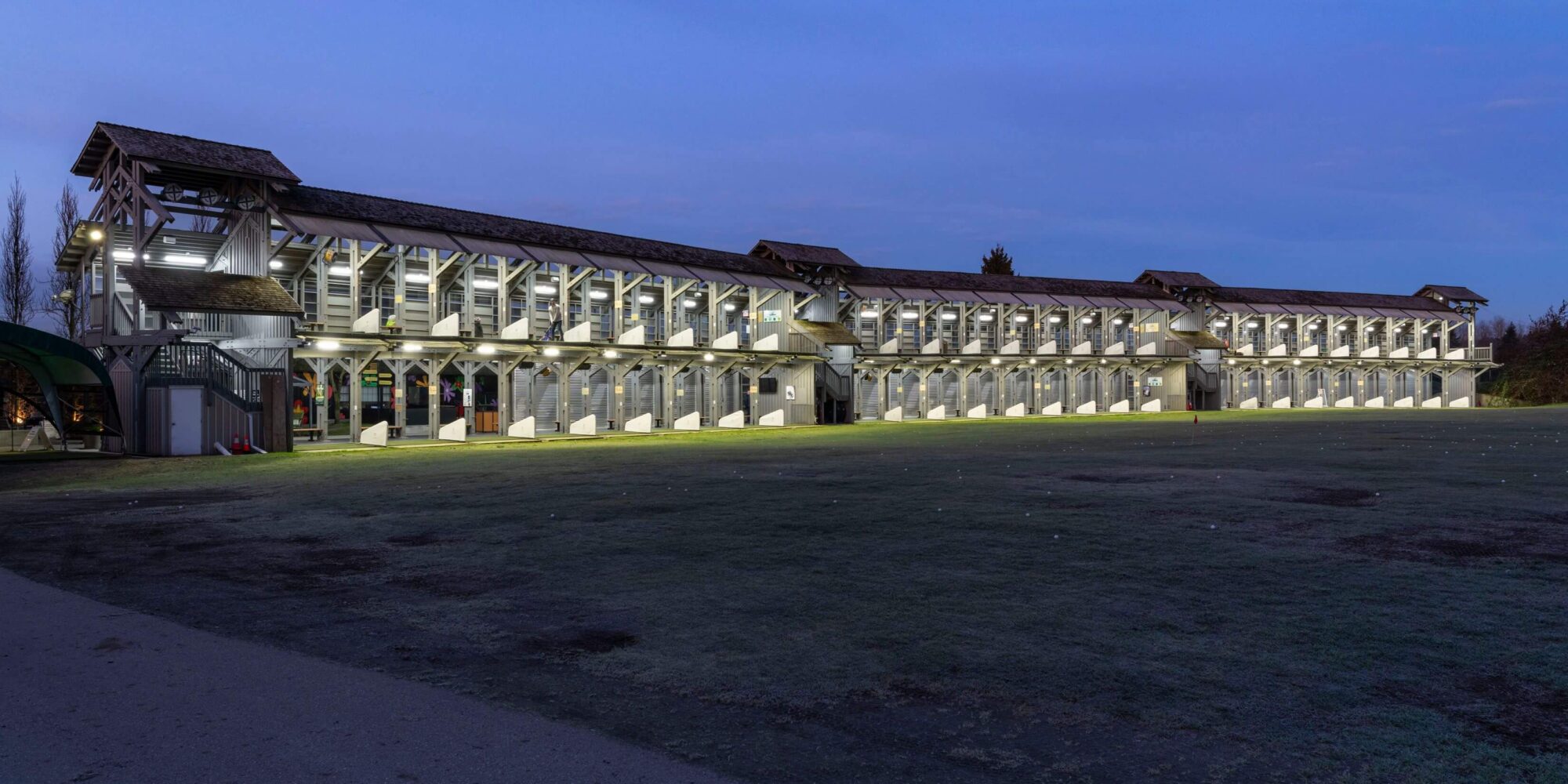
At Riverway Golf Course, poor lighting affected both the tee deck and the first 30 yards of the range. Following a competitive process involving four suppliers, the City of Burnaby selected Netex to develop a photometric lighting plan and install T-deck and hallway lighting throughout the facility’s two-level driving range.
A key part of the plan was the Netex T-deck light installed directly above each golfer. Each fixture has two lenses that can be aimed separately. One directs light downward over the golfer and hitting area, while the second angles 15 degrees forward to illuminate approximately 15 feet in front of the tee deck. This configuration was designed to reduce the dark zone immediately in front of the golfer.
The system included 52 Netex 70W Smart Control Linear High Bay fixtures and 110 Netex 60W Smart Control Strip Fixtures. The T-deck lights addressed the hitting bays and the area immediately in front of them, while high-mast lights and LED floodlights provided broader coverage across the tee deck and the first 30 yards of the range.
Smart controls gave the facility greater control over when and how the lights operated. According to Netex’s published project results, the system improved visibility while reducing energy and maintenance costs.
Riverway demonstrates why photometric planning belongs in the ROI conversation. Energy efficiency matters, but the light still has to reach the golfer and the area where they need to track the ball.
What Riverway demonstrates: A successful LED retrofit reduces wasted energy without trading away visibility. That requires a lighting plan built around the facility.
Build the ROI Around the Whole System
Energy savings are only one part of the return. Calculating sports lighting retrofit ROI means accounting for the full system, not just the fixtures.
LED controls may allow a facility to dim lights during cleaning, operate only the areas in use, or align lighting more closely with its booking schedule. Maintenance can add another layer of savings when longer service intervals reduce replacement labour and the need to access elevated fixtures.
Your upfront calculation should include:
- Fixtures and lighting controls.
- Electrical and installation work.
- Removal of the existing system.
- Required mounting or structural changes.
- Confirmed rebates or incentives.
Subtract any confirmed rebates or incentives from the project cost. A simple payback estimate then looks like this:
Payback period (years) = (total project cost − confirmed rebates) ÷ (annual energy savings + annual maintenance savings + annual net operating value)
For a rentable sports facility, net operating value may include bookings that can genuinely be scheduled. For an industrial facility, it may come from greater control between shifts or faster recovery after a power interruption.
The proposal should also explain the installation schedule, warranty coverage, maintenance responsibilities, and assumptions behind the projected savings.
The practical takeaway: The most useful ROI calculation includes the full cost of installing and operating the system, supported by assumptions that can be checked before approval.
Conclusion: Calculate the Return Around Your Facility
LED sports lighting can remove the warm-up and restrike limitations associated with many metal halide systems. It can also reduce energy and maintenance demands while giving operators more control over when and where their lights are used.
The most reliable LED sports lighting energy savings estimate begins with your current system load, operating schedule, utility costs, and lighting requirements. Any potential rental value should be based on time that can genuinely be recovered and booked.
The strongest lighting upgrade is not simply the one that uses fewer watts. It is the one designed around how your facility operates and where players need to see.
Your lighting ROI depends on more than fixture wattage. Netex can assess your existing system, operating schedule, and coverage requirements, then develop a coordinated plan from photometric design through installation.
About the Author
Mark Wilson is the founder of Netex Netting (Netex Canada Netting Inc.), a global leader in golf and baseball netting systems. With 47 years of net fabrication expertise, including 30 years working specifically on golf ranges, he pioneered low-drag Dyneema® golf nets and designed integrated pole, lighting, and turf solutions. He also developed the Dyneema® #15, the thinnest-diameter, lowest-wind-drag twine used on backstop safety nets at every MLB park today, earning certified wind tunnel test approvals along with the first-ever certified burst and break strength testing for a baseball backstop net. Netex delivers precision installations worldwide and stands behind them with industry-leading warranties.