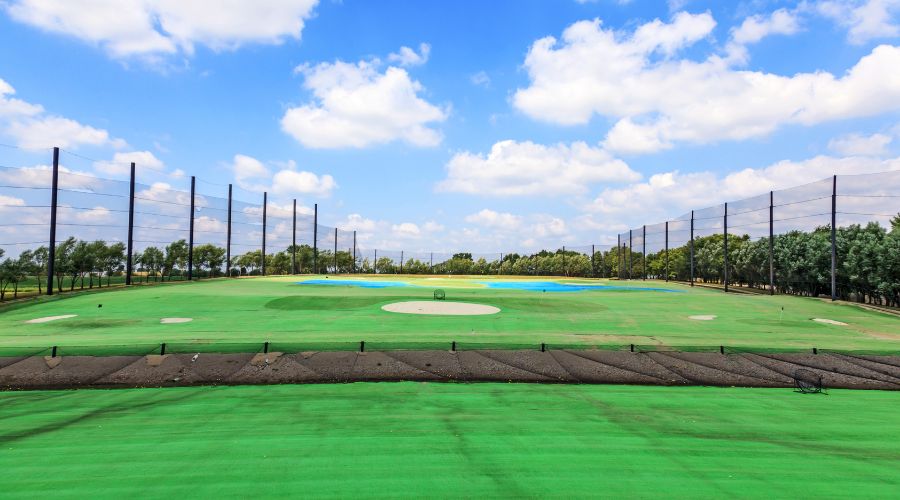
Designing the Ultimate Golf Driving Range: Integrating High-Performance Nets and Poles to Maximize Facility ROI
Building a state-of-the-art golf facility is a major capital investment. But the highest risks rarely lie in the materials themselves; they lie in the execution.
Facility owners and developers often face unexpected hurdles when critical infrastructure like poles, nets, lighting, and turf is split among disconnected vendors. This fragmented approach frequently leads to delays, unbudgeted change orders, and compromised safety standards.
Instead of juggling disconnected subcontractors and holding your breath, this guide shows you how a single-source partner takes on the engineering, the liability, and the schedule, so you can focus on opening a world-class facility.
Key Takeaways:
- Custom engineering is non-negotiable: Site-specific wind load calculations and structural designs protect the facility from liability and catastrophic failure.
- Segmented contracting creates friction: Splitting bids among multiple vendors introduces hidden costs, schedule delays, and quality control gaps.
- Turnkey integration solves trade conflicts: A single-source provider handles design, fabrication, and installation, ensuring total accountability.
- Multi-system coordination maximizes value: Installing netting, lighting, and turf in a synchronized sequence protects the materials and accelerates the project timeline.
Engineering for Liability and Longevity: Moving Beyond the Basics
When you stand on the site of your future driving range, it is easy to focus on the final vision. You picture players teeing off under bright lights, tracking their ball flight against a clear sky over a flawless green surface. But the true success of your project, and the quality of that player experience, rests entirely on the invisible math beneath your feet and the engineering above your head.
Let’s talk about wind. A 50-foot-high wall of golf netting acts exactly like a massive sail on a ship. If your poles and concrete foundations aren’t rigorously engineered for the specific wind conditions of your exact location, that sail can literally pull your investment to the ground. We aren’t just talking about replacing a torn net here; we are talking about a significant safety hazard and a massive failure in facility risk management.
This is why generic, out-of-the-box pole spacing is a recipe for disaster. Every single site requires a custom approach. The only way to ensure your system stands strong through severe weather is to rigorously apply site-specific structural engineering standards, aligning with the National Building Code of Canada (NBC) and ASCE 7 guidelines for structural wind loads, long before the first piece of steel is fabricated.
The exact same principle applies to your materials. In the past, heavy, thick netting was the only way to achieve durability, which often left players feeling like they were hitting inside a cage. Today, sourcing high-break-strength, low-drag mesh, like advanced Dyneema Netting Systems, fundamentally changes both the engineering profile and the player experience. Because this modern fibre is exponentially stronger, the mesh can be manufactured significantly thinner.
For your structural engineer, a thinner mesh means massively reduced wind drag, lowering the strain on your custom steel poles. But for your players, it creates a near-invisible barrier. Instead of staring at thick ropes, athletes and patrons enjoy an unobstructed, premium aesthetic, elevating the experience of the entire facility. That open, spacious feel isn’t just a nice-to-have; it elevates the perceived value of your facility, justifying higher bucket prices and driving repeat business. It is a strategic investment that lowers your lifetime maintenance costs while simultaneously enhancing the customer experience.
A Tip From the Field: Always verify that your project engineers have accounted for winter ice accumulation in their wind load calculations. A net coated in a thin layer of freezing rain effectively becomes a solid wall, catching more wind exponentially and placing massive, unexpected stress on your poles and foundations.
The Hidden Risks of Segmented Contracting
You’ve done your research, you’ve ordered top-tier materials, and now it’s time to build. But instead of hiring one team to handle the whole system, you’ve got one company sinking the poles, another handling the driving range netting installation, and maybe a third running the electrical for the lights.
On paper, splitting the bids might have looked like a smart way to save a few dollars. In reality, it is a perfect recipe for what we call “contractor trauma.”
Have you ever stared at a massive change order and realized you are paying two different contractors to argue over who misread the blueprint? Here is how the scope gap usually plays out. The pole contractor finishes up, packs their trucks, and heads home. Next week, the netting crew arrives. They take one look at the site and tell you the poles are off by two inches, so the custom nets you ordered won’t fit. The pole contractor says they built to the drawing. The netting contractor says the site doesn’t match the drawing.
Who ends up paying for the expensive change order to fix it? You do.
Then there is the timeline friction. Coordinating separate trades for netting, turf, and lighting is like trying to conduct an orchestra where no one has the same sheet music. If the lighting crew gets delayed by a few days, the turf installers can’t safely get their heavy machinery onto the field. Suddenly, one small hiccup cascades, and your grand opening is pushed back by a month.
In fact, research from the Project Management Institute (PMI) indicates that nearly half of global construction projects exceed their original schedules. The study identifies poor coordination and inadequate communication between disconnected teams as primary drivers of these delays, which often lead to significant cost overruns and project friction.
When you segment your project across different vendors, you aren’t just managing construction. You are managing their conflicts. And that is a full-time job you didn’t sign up for.
A Tip From the Field: If you find yourself absolutely forced to use multiple contractors, mandate a pre-construction meeting on-site with all the foremen present at the same time. Get them to explicitly agree on the installation sequence and sign off on the handover tolerances before a single piece of steel goes into the ground.
The Blueprint for Single-Source Integration
The most effective way to eliminate construction friction is to remove the gaps between the trades entirely. When building a high-performance sports facility, true peace of mind comes from knowing a single, accountable team is handling the project from the first engineering drawing to the final safety inspection. This is the power of turnkey sports facility construction.
It all begins with a unified design. When structural steel, custom netting systems, and LED lighting are engineered concurrently under one roof, on-site surprises practically disappear. When everything is engineered concurrently, on-site surprises disappear:
- Pole placements perfectly match the exact net tensioning requirements.
- Electrical pathways are planned long before concrete is poured.
- Heavy equipment routes are mapped to protect sub-bases.
The true value of this approach really shines during the installation phase. Relying on seasoned, in-house crews rather than a patchwork of temporary subcontractors ensures a massive leap in quality. The craftsmen building the system intimately understand how all the complex pieces connect. They know the materials, they know the tolerances, and they take immense pride in the finished product.
Ultimately, it comes down to accountability. A single-source provider offers one clear point of contact, one streamlined timeline, and comprehensive, industry-leading warranties covering your facility’s core systems. There is no finger-pointing and no shifting the blame. If a complex challenge arises on the site, the same team responsible for the design is already there, ready to solve it and keep the project moving forward.
A Tip From the Field: When reviewing facility upgrade proposals, always ask vendors if their installation teams are in-house employees or subcontracted labour. A true turnkey partner will prioritize using their own experienced crews to guarantee strict quality control across every stage of the build.
Maximizing Asset Value with Multi-System Coordination

A premier sports facility operates like a well-oiled machine, where every component works in perfect harmony. Achieving that seamless environment requires looking beyond just the perimeter safety netting. The true value of a project is unlocked when multiple systems are coordinated from the very beginning.
Take lighting, for example. Engineering energy-efficient LED Lighting Systems directly into the initial pole and netting design offers massive operational advantages. It ensures the structural steel is correctly rated for the additional weight and wind load of the light arrays from day one. It also allows for precise photometric planning, meaning the lights are positioned to illuminate the field perfectly without casting distracting shadows through the mesh. The ROI on this type of operational efficiency, often resulting in energy savings of 50% or more, is well-documented in industry case studies from Athletic Business.
The sequence of installation is equally crucial, especially when high-performance Artificial Turf Systems are involved. Heavy machinery, such as the augers and cranes required for erecting 60-foot steel poles, is incredibly hard on the ground. When different companies are pushing to hit their own separate deadlines, it is common to see heavy equipment rolling over newly prepared sub-bases or even finished turf, causing thousands of dollars in damage.
Building a facility out of sequence is like painting your house before you’ve run the plumbing; you are just paying for the privilege of tearing up your own work. An integrated approach naturally solves this sequence problem. The steel goes up, the heavy equipment rolls out, and only then is the pristine turf system laid down. The site remains organized, the materials are protected, and the risk of costly rework plummets.
Research published in the Design-Build Institute of America (DBIA) SmartMarket Report highlights that integrated project delivery methods are essential for overcoming traditional construction friction. While 76% of owners who have utilized Integrated Project Delivery (IPD) report experiencing reduced construction schedules, the impact is even more pronounced in high-performance Design-Build projects, which have demonstrated the ability to compress schedules by more than 50% compared to traditional delivery methods. This streamlined approach drastically cuts down the administrative hours usually spent untangling the schedules of disjointed trades and prevents the cascading delays common in fragmented construction models.
A Tip From the Field: When mapping out a multi-system upgrade, always plan the heavy equipment access routes first. A boom lift needed for high-mast lighting requires significant ground clearance and a stable path, which must be factored into the site plan long before any foundational turf work begins.
Conclusion: Build With Confidence, Finish What You Start
The ultimate driving range is defined by safety, playability, and the complete peace of mind of the stakeholders who funded it. Precision materials are essential, but they only perform as well as the team integrating them into the site.
By moving away from the traditional model of segmented contracting and embracing a turnkey approach, developers can effectively eliminate construction friction. Unified engineering, seasoned in-house installation crews, and synchronized project management ensure the facility is built safely, on schedule, and right the first time.
The next step for any upcoming facility build or renovation is to evaluate the project through a holistic lens. Reach out to the in-house engineering team at Netex to review your current facility plans or technical requirements. Discovering how synchronized engineering for nets, poles, and lighting can streamline your construction timeline is the most effective way to protect your investment and guarantee a world-class result.
A Tip From the Field: At the end of any major build, request a comprehensive closeout package from the contractor. Having all structural CAD drawings, photometric lighting plans, material specs, and warranties bound in one place makes future maintenance and facility management incredibly straightforward.
Frequently Asked Questions (FAQ)
Why can’t I just buy the netting and poles separately to save money? While buying materials separately might look cheaper on paper, it often creates “scope gaps” where contractors disagree on tolerances and measurements. This leads to expensive on-site change orders, delayed timelines, and points of friction where no single vendor takes full accountability for the finished system.
Do you handle the engineering permits and wind load calculations? We handle the technical heavy lifting on the structural engineering side, working collaboratively with your local experts to finalize the paperwork. Netex provides comprehensive, site-specific structural engineering, including certified wind tunnel test results, material break strengths, and stamped drawings for all structural work above grade. We then supply precise ‘base moment load’ data to your local civil engineer, giving them the exact specifications needed to design foundations and apply for your municipal permits with confidence.
What makes modern golf netting “near-invisible”? Older nets relied on thick nylon ropes for durability, often creating a caged-in feeling for athletes. Modern systems use high-break-strength fibres like Dyneema, which are exponentially stronger. Because the fibre is stronger, the mesh profile can be manufactured much thinner, drastically reducing wind drag while giving players an unobstructed view of their ball flight, whether they are tracking a drive or a line drive. You can learn more about our materials and wind tunnel testing on our Why Netex page.
Can I integrate LED lighting on existing netting poles? It depends entirely on the original engineering of the poles. Lighting fixtures add significant weight and wind load. A structural assessment is required to determine if the existing steel and foundations can safely handle the additional stress, which is why engineering poles and lighting concurrently during a new build is the safest, most cost-effective method.
About the Author
Mark Wilson is the founder of Netex Netting (Netex Canada Netting Inc.), a global leader in golf and baseball netting systems. With 47+ years of net-building expertise, he pioneered low-drag Dyneema® golf nets and designed integrated pole, lighting, and turf solutions. Netex delivers precision installations worldwide and stands behind them with industry-leading warranties.