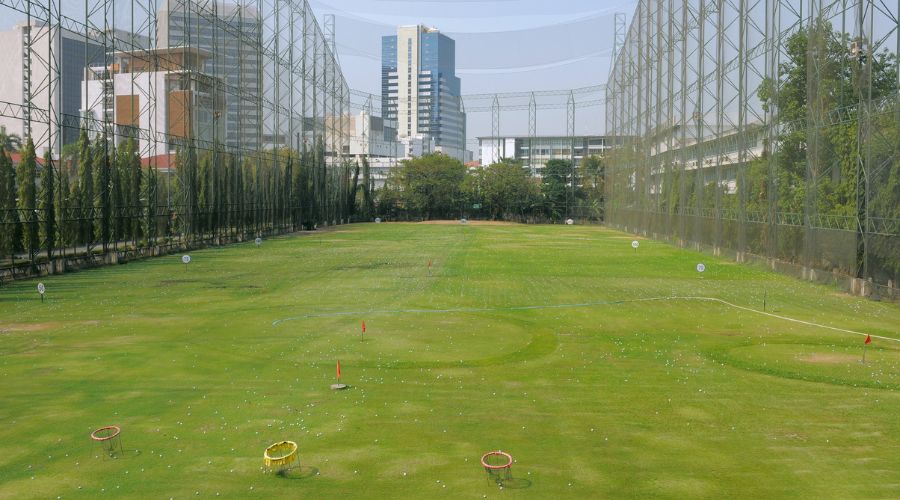
Engineered Driving Range Poles: Reclaiming Space & Streamlining Facility Builds
Every driving range build starts with a big number attached to it. But the real risk to your return isn’t sitting in that budget, it’s in how much of your own land the build quietly costs you.
When you’re planning a new facility or upgrading an existing one, every square foot of your property matters. Yet, many facility owners and developers lose prime commercial real estate to the sprawling footprint of traditional golf netting poles.
Instead of sacrificing your land to outdated anchors and guy-wires, this guide shows you how upgrading to engineered, freestanding poles can completely transform your site plan. We will look at how the right structural choices not only save your usable space but also streamline your entire build.
Key Takeaways:
- Reclaim Your Space: See how moving away from traditional guy-wires frees up land for revenue-generating hitting bays and expanded turf.
- Simplify Approvals: Learn how a cleaner, wire-free visual profile makes municipal permitting faster and easier.
- Bundle Your Build: Discover the time-saving benefits of integrating your netting, lighting, and turf under one accountable roof.
The Hidden Cost of Traditional Guy-Wire Systems
Imagine looking at an empty plot of land and seeing nothing but potential. You’re mapping out hitting bays, plotting where the new turf will go, and picturing the whole facility lit up under the night sky. But then the blueprints come back, and suddenly, a massive chunk of your usable land is gone.
Where did it go? It was eaten up by the structural footprint of traditional guy-wire netting systems.
Traditional netting poles rely on an extensive network of cables and ground anchors to stay upright. Think of it like rigging a temporary suspension bridge; it requires a massive, sprawling anchor footprint just to hold the vertical loads. On a driving range, those thick steel guy-wires require a mathematical setback angle. Depending on the pole’s height, this means dedicating dozens of horizontal feet per pole purely for cable anchoring.
Why pay premium commercial land rates just to house a dead zone of steel cables? That is land you are paying for, but land you can’t actually build on or use for your guests.
Losing that space is frustrating enough when you are trying to maximize your return on investment. But the headaches don’t stop at the property line. Over time, ground anchors shift and settle. Wires naturally lose their tension. That means someone is constantly out there adjusting them to keep the netting secure, adding to your ongoing maintenance costs and liability risks. When you are trying to manage a safe, clean golf range net infrastructure, these hidden structural liabilities quickly add up.
Expert Field Note: When evaluating your initial site plans, grab a highlighter and mark the exact “dead zones” required by wire anchors. You will quickly see how many potential revenue-generating hitting bays, practice greens, or parking spots are being sacrificed just to hold the netting up.
Losing valuable square footage to outdated netting anchors? Contact our team to discuss your site plans and see exactly how much space a freestanding pole system can help you reclaim.
Engineering for ROI: The Freestanding Pole Advantage
So, if we take away all those bulky wires and anchors, how do these massive poles stay standing during a heavy storm?
It all comes down to smart, modern engineering. Instead of using rigid cables to fight against the weather, freestanding poles are designed to work smoothly with it. This is where pre-cambering comes in. Pre-cambered simply means the poles are engineered with a slight pre-bend. Think of a tall, healthy tree out in the woods. When a strong gust of wind hits, the tree doesn’t stay perfectly stiff—it bends and flexes just enough to absorb the energy. Our freestanding netting systems do the same thing.
Because they safely flex to absorb structural wind loads, they completely eliminate the need for those sprawling ground anchors. When you drop the wire footprint, you unlock prime real estate right on your property line.
You can use that extra space to add more revenue-generating TrackMan hitting bays alongside your golf driving range nets. Or, you could simply offer a larger parking lot for your guests. Suddenly, your netting infrastructure isn’t just a safety requirement—it is directly boosting your bottom line.
And you never have to worry about compromising on safety or containment. Freestanding systems are fully engineered to meet rigorous regional wind load standards and structural codes — such as ASCE 7 in the US — ensuring your nets stay secure and your neighbours stay happy.
Expert Field Note: When you are sketching out your facility master planning, calculate the expected revenue of just one extra hitting bay over five years. You will quickly see how investing in a freestanding pole system can pay for itself just by giving you the physical space to build.
Navigating the Permitting Minefield
If you have ever sat through a city planning meeting, you know that getting approval for a towering commercial site footprint can feel like climbing a mountain.
Community pushback is a very real hurdle. Neighbours worry about structures blocking their sunsets. At the same time, city engineers want rock-solid proof that your multi-sport complex construction will stand up to the harshest local weather. When you submit plans that include a messy, sprawling web of traditional cables and anchors, you are almost inviting extra scrutiny and delays.
By removing external guy-wires, you present a cleaner visual profile that drastically reduces community pushback and fast-tracks municipal approvals.
Because they don’t require external support wires, freestanding poles blend into the skyline rather than cluttering it up. A tapered pole design takes this even further: it’s more aerodynamic, reducing the wind loads on the structure, and its reduced mass creates a cleaner, more aesthetically pleasing profile in the skyline. For city planners and residents, that minimal visual impact makes a world of difference.
But looking good is only half the battle. You still need the hard math to prove it is safe. Working with a single, experienced partner who handles the engineering in-house means you walk into that city council meeting fully armed. At Netex, we provide the exact wind load calculations, base moment loads, and structural safety documentation your local civil engineer needs to design the foundations and fast-track your RFP or permit application.
Expert Field Note: Never wait for the city to ask for your environmental and structural safety documentation. Bring fully completed, RFP-ready engineering specs to your very first planning meeting to show the board you are prioritizing community safety right out of the gate.
Multi-System Integration: One Vendor, Zero Headaches
Let’s talk about the biggest headache in any facility build: managing the trades. When timelines inevitably shift, subcontractors end up pointing fingers at each other, leaving you to clean up the mess. You know the drill:
- The netting contractors delay the schedule.
- The electrical teams are stuck waiting on the netting crew to finish.
- The turf installers are unable to pour concrete until the heavy equipment leaves.
By upgrading to engineered poles, you open the door to a seamlessly bundled solution. These structures are robust enough to support heavy-duty LED lighting arrays on the same framework. That means you eliminate the need for separate, expensive lighting masts.
When you work with a single, accountable partner, one team manages the concrete footings, erects the poles, installs the lighting, and lays the turf right up to the boundary line. Facilities that consolidate these trades into a single turnkey contract drastically reduce administrative delays and unbudgeted change orders.
Expert Field Note: Before you sign any contracts, ask your netting provider if they handle their own installations or if they simply drop-ship materials and subcontract the labour. True accountability only happens when the company designing the system is the same one pouring the concrete.
Conclusion: Build Smarter, Not Wider
At the end of the day, these engineered netting structures are so much more than just a safety requirement. They are the structural foundation of your facility’s profitability.
By choosing engineered, freestanding poles, you are actively choosing to optimize your land. You are reclaiming the valuable space that traditional wires leave dead and useless. And when you partner with an integrated vendor who can handle the netting, the LED lighting, and the artificial turf all at once, you reclaim your most valuable asset of all: your time.
True project success comes from working with a partner who finishes what they start and handles the complex coordination entirely in-house. So, take a close look at your current site plans. If you see wires eating into your profit margins, it is time to build smarter.
Don’t let uncoordinated trades and outdated structural footprints limit your facility’s potential. Contact our netting specialists today to get a quote on our one-stop sports solutions, from engineering your freestanding poles to integrating your LED lighting and sports turf.
About the Author
Mark Wilson is the founder of Netex Netting (Netex Canada Netting Inc.), a global leader in golf and baseball netting systems. With 47+ years of net-building expertise, he pioneered low-drag Dyneema® golf nets and designed integrated pole, lighting, and turf solutions. He also developed the Dyneema® #15 — the thinnest-diameter, lowest-wind-drag twine used on backstop safety nets at every MLB park today — and earned certified wind tunnel test approvals, along with the first-ever certified burst and break strength testing for a baseball backstop net. Netex delivers precision installations worldwide and stands behind them with industry-leading warranties.
Frequently Asked Questions (FAQ)
What is the main advantage of freestanding poles over traditional wire-anchored systems?
The primary advantage is the massive reduction in your facility’s structural footprint. Freestanding or pre-cambered steel poles are engineered to naturally flex and absorb wind loads without relying on a sprawling web of cables and ground anchors. This allows you to reclaim valuable square footage directly on the property line for revenue-generating assets like extra hitting bays or expanded turf. You can learn more about how we design these structures on our engineered netting solutions page.
How high can engineered freestanding poles be built?
With modern structural engineering and the use of ultra-lightweight, high-strength netting materials, freestanding systems can reach impressive heights while maintaining a minimal footprint. At Netex, our engineered tapered steel poles can be built up to 200 feet (61m) high. Furthermore, by pairing these poles with our advanced high-performance netting, we can achieve industry-leading spans of up to 82 feet between poles.
Can LED sports lighting and netting be installed on the same poles?
Yes. One of the greatest benefits of upgrading to engineered steel poles is the ability to bundle your facility’s infrastructure. Our support poles are rigorously engineered to accommodate heavy-duty netting and LED stadium lighting installations on the same framework. This eliminates the need for separate, expensive lighting masts, which dramatically reduces visual clutter, simplifies the municipal permitting process, and lowers overall project costs.
Does the type of netting affect the required pole infrastructure?
Absolutely. The weight and wind drag of your netting dictate the size, strength, and spacing of your poles. Heavy materials like traditional nylon or standard polyester catch more wind, requiring thicker poles placed closer together. Upgrading to an ultra-light, high-strength material like Dyneema® results in significantly reduced wind drag, enabling a lighter pole structure and much wider spans. For a deeper dive into how materials impact your build, read our facility manager’s guide to netting materials.