
Golf Course Netting: How to Protect Roads, Homes, and Clubhouses Beyond the Range
Most conversations about golf netting stop at the driving range. But if you manage a golf facility, you know stray balls can reach roads, homes and the clubhouse from out on the course too.
Maybe a neighbour has already called about balls in their yard, or one has bounced across the road. Either way, you need a plan to prevent it from happening again, and a plan you can get right the first time without shutting down play.
This guide walks you through how to plan golf course netting beyond the range, using real course examples and Netex’s own design process.
Key takeaways:
- A trajectory study sets where netting goes and how tall it should be for each hole.
- Redesigning a hole can reduce stray shots, but may not stop them.
- Fairways and boundaries need golf barrier netting, while tee boxes and waiting areas need tougher impact netting.
- Low-drag netting and freestanding poles mean fewer poles, more usable space and cleaner views, without clearing trees.
- A record of errant balls gives you and your netting partner a clear starting point.
Why Golf Course Netting Is a Different Problem from Range Netting
On a driving range, every golfer hits in the same direction, so it’s fairly easy to predict where a wide shot will go. A golf course is different: some holes run beside a road, others back onto homes, and the clubhouse and parking lot sit somewhere in between. Each hole also points in its own direction, over its own terrain. If your main concern is the range itself, our guide to urban driving range nets covers it in detail.
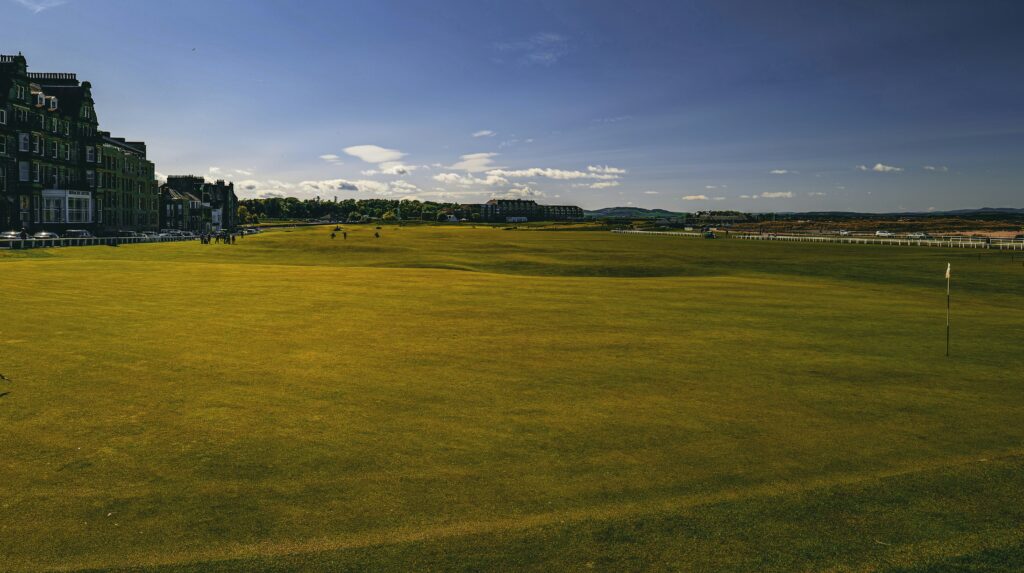
At Netex, we’ve been designing and installing golf barrier netting for courses and driving ranges since 1997, in places like Canada, the USA, Australia, Korea and Taiwan. One lesson keeps coming back: on a course, a good netting plan has to look right and work technically on every hole it protects.
Getting there starts with knowing how far off line shots really go. The Royal and Ancient Golf Club of St Andrews (R&A), one of golf’s governing bodies, measured more than 2,000 amateur drives a year at six courses in Scotland. Only half landed within 20 yards of the middle of the fairway, the strip of short grass golfers aim for. About one in ten landed more than 40 yards away. In other words, if a road or a row of homes sits within 40 yards of a fairway, some drives could reach it.
Worth knowing: Misses aren’t split evenly. Most golfers are right-handed, and the R&A data shows less-skilled golfers tend to miss to the right more often. That’s why course designers expect more shots to leave the right side of a hole than the left. If one of your holes has a road or a home on its right, that side deserves a closer look.
Knowing where balls are likely to go is one part. The other is what’s at stake if they keep leaving your course.
What Errant Balls Really Cost You
In 2019, a golf ball cracked the siding on a home beside a course in Nova Scotia. The next year, another ball cleared the same house and dented the owner’s truck in the driveway. The homeowner took the club to small claims court, and in 2023 the club was found liable.
The damages were small. What stands out is the court’s reasoning. It agreed that the risk of errant balls will never be zero, but said courses can take steps to keep it low. Or, as the court put it, “there is no shortage of bad golfers, and even good golfers make bad shots.”
That’s really the heart of it. Canadian law expects golf course owners to reasonably keep balls from landing on neighbouring properties. And if balls keep reaching the same homes or the same road, it’s hard to say you didn’t see it coming.
On top of that, some cities, like Mississauga, now require golf ball containment netting when balls keep leaving a property.
Key takeaway: Start keeping a record of where stray balls land, how often, and what they hit. That record helps show which holes need attention first.
Know which holes are sending balls off your property? Share your course layout and those problem spots with us, and our design team will map where golf barrier netting is needed and how tall it should be.
And that leads straight to the first real step: working out exactly where netting needs to go.
Where Does Golf Course Netting Need to Go?
Your record shows which holes are causing trouble. But it won’t tell you where the poles should go or how tall the netting needs to be. For that, you need a trajectory study.
How Netex starts a course netting plan
This is where our design consultation for golf ranges and fairways comes in. It starts with what you already know about your course: a concept sketch plus some basic layout, size and elevation details.
From there, we develop a preliminary site plan with recommended netting heights and a pole layout. Then our team visits your course to check site conditions and confirm pole locations, spans and elevations.
What a trajectory study looks at
A trajectory study, sometimes called a spray analysis, looks at each tee and works out where errant shots are likely to land. Then it shows which parts of your property line are exposed and where golf course boundary netting would do the most good.
Golf course designers start by mapping how far shots usually stray from each tee and around each green. Then they adjust for wind, slope and what sits beyond your fence. That includes tees and greens near your clubhouse windows, patio or parking lot, not just the holes beside a road.
That’s why heights can vary so much, even on the same course. At Seattle’s Jefferson Park Golf Course, trajectory studies for two holes beside city streets called for fairway netting on poles from 20 to 160 feet tall. A single “standard” height rarely fits a whole course.
Once you can see where the risk is, the next question comes naturally: is netting the only answer?
Netting vs. the Alternatives: Redesigning Holes, Moving Tees, and Adding Trees
Before choosing netting, it’s fair to ask whether a smaller change to the course could fix the problem. Rye Golf Club in Rye, New York, found out. Neighbours along one section of the course had raised concerns about tee shots on Hole 5 landing on their properties. The club first tried changing the hole itself. According to a 2018 review by Lohmann Golf Designs, the club added bunkers, planted tall grass and widened the fairway away from the homes.
Those changes seemed to cut down the number of balls leaving the property. Still, they didn’t solve it.
How the alternatives compared
The review also weighed other options. Here’s how they stack up, along with Seattle’s experience:
| Option | What it can do | The trade-offs |
| Adding mature trees | Gives some protection and looks better than netting | Costly to bring in ($50,000 or more per tree), and still below many shots |
| Moving or rebuilding tees | Can aim players away from homes | May just move the problem further down the hole |
| Rerouting holes | Changes the direction of play | Seattle dropped it over permits, closures and cost |
| Netting | The most effective way to stop all types of shots | Cost, views from nearby homes, and maintenance |
Looking at the options side by side, each one solves part of the problem, but only netting covers every type of shot. Even then, the Rye review is clear that netting companies generally won’t guarantee 100% containment. We agree, and a good netting partner should tell you that up front instead of overpromising.
How tall does netting really need to be?
Do you need netting tall enough to stop every possible drive, or the shots most of your players actually hit? This part matters if you’re working with a tight budget. At Rye Golf Club, the review found that stopping even the fastest drives on the hole beside the neighbours’ homes would take netting around 120 to 130 feet tall, partly because its tees sit about 45 feet above the fairway. Still, since most players don’t swing that fast, even 50- to 60-foot netting would be reasonably effective compared with having none.
In short, the right height depends on how much protection you need and what your site and budget allow. Height is only one decision, though. How the netting looks and what it takes to maintain mostly come down to how the system is designed.
Designing Golf Barrier Netting That Fits the Course
Two nets, two different jobs
Not every net on a course does the same work. In fact, we use two types:
- Barrier netting goes along fairways and property lines. By the time a ball reaches it, the ball has travelled a long way and slowed down. That’s why barrier netting uses the largest mesh that still stops a ball. Bigger openings let more wind through, which matters when netting sits high on tall poles.
- Impact netting goes where a ball can hit it at full speed, like beside a tee box or along a path where players wait their turn. A drive can come off the club close enough to break through barrier netting, so impact netting uses a smaller mesh and thicker twine to absorb that energy.
Think of it this way: barrier netting catches a ball that’s run out of steam, while impact netting has to stop one that’s just left the club. That’s also why the paths and waiting areas near your clubhouse often need different netting from the fairway beside them.
Poles that stand on their own
Traditional golf netting poles often rely on guy wires, the cables that run from the top of a pole down to anchors in the ground. They work, but they take up space. On a course, that can mean cables crossing into rough, cart paths or right up to your property line.
We use engineered, tapered steel poles instead. The end, corner and angle poles can be designed as freestanding and precambered. That means the pole is built with a slight curve, so it stands straight once the netting pulls on it. With no guy wires, there are no cables to maintain and nothing for players or neighbours to walk into.

That freedom matters on a tight site. At Metropolitan Golf Club in Melbourne, Australia, we used precambered poles so the system could sit right at the edge of the property, making the most of the club’s land.
That design also gives us an edge on courses lined with mature trees. Typically, a netting system needs a straight run of poles, and that often means clearing trees along the property line. Because our precambered poles stand without ground anchors, we can lay out the netting around existing trees instead of clearing them. Homes along the fairway get the protection they need and keep the trees that give them privacy. The same approach works beside schools and other spots where clearing isn’t an option.
Built for uneven ground
Golf courses are rarely flat, and if every pole is the same height, the top of the netting rises and falls with the ground.
We handle this by fabricating each pole to its own height, so the top of the netting forms one straight line across the horizon and looks clean from the neighbours’ side. We also tension the cables higher than most companies do, which keeps the nets taut season after season. Some of the barrier netting we installed 26 years ago still stands straight and tight today.
Netting that’s easier on your poles
The netting you choose affects more than the view. It also decides how much wind your poles have to fight.
Our certified wind tunnel testing showed our Dyneema® golf net catches less wind than typical polyester nets. Less wind on the net means each pole carries less load, which allows wider spans between poles. As I once told Business in Vancouver, Dyneema is “the strongest fibre you can use to produce a thin mesh size” while still giving you the strength needed to hold balls back.
Here’s how that worked at Canterbury Golf Club in Cleveland, Ohio, a course that has hosted the US Open and the PGA Championship. As Mike Lopresti, the club’s golf course superintendent, put it: “The Dyneema netting allowed us to go from 9 poles to 5 while still covering the same span.”
That said, Dyneema isn’t automatically the right choice everywhere. It tends to make the most sense where poles are tall and expensive, because using fewer of them offsets the higher cost of the netting. On shorter, less expensive poles, a heavy-duty polyester net can be the smarter buy. We walk through that math in our golf range net replacement guide.
Golf Net Installation: Approvals, Engineering, and Keeping the Course Open
Engineered netting needs proper foundations, and that takes a few people working together. Here’s how our process for golf projects splits the work:
- Your facility: arranges a geotechnical report, a soil test that shows what kind of foundation each pole needs. We can’t finalize the design without it.
- Netex: engineers the poles and stamps the drawings for everything above ground.
- A local civil engineer: designs and stamps the foundations.
Permit rules vary by municipality, so it’s worth talking to your local building authority early. Building codes like the National Building Code of Canada set the wind loads structures must handle, and those stamped drawings are usually what your building department will want to see.
Keeping the course open
Course-wide netting doesn’t always mean shutting everything down. At Jefferson Park in Seattle, the city planned to keep the course open during construction of its new netting along two holes.
Still, every course is different. When you’re comparing proposals, ask for a timeline that shows what happens each week, not just a start and end date.
Key takeaway: Ask who will actually be on your course. Our install teams are hand-picked from the areas where they work, and they install to our specifications. Every installation comes with a 2-year workmanship warranty. That means one company stands behind the design, the fabrication and the work on site.
With the process in mind, the last step is getting your own information ready.
What to Have Ready Before You Talk to a Netting Partner
Before that first conversation, it helps to gather a few things you probably already have:
- A course map with the problem holes marked. A simple sketch works, since our design consultation starts with one.
- Your record of errant balls. Note where they landed, how often, and what they hit.
- Distances to what you’re protecting. Measure from your tees and landing areas to the nearest roads, homes, parking lots and clubhouse windows.
- Elevation details. Note any tees that sit well above the fairway, or holes that run up or down a slope.
- Details on any existing poles or netting. Include their height, spacing, age and material.
- Any complaints or city requests on file. They help show which areas matter most.
If you’re taking a recommendation to an owner or a board, the same list helps you explain why the project is needed and where it should start.
Conclusion
Start with a trajectory study, weigh the alternatives, and if netting is the right call, choose golf course safety netting built for your terrain and your neighbours.
Once you’ve gathered the information above, send it our way. Our design team will review it with you and recommend where to start.
About the Author: Mark Wilson is the founder of Netex Netting (Netex Canada Netting Inc.), a global leader in golf and baseball netting systems. With 47 years of net fabrication expertise, including 30 years working specifically on golf ranges, he pioneered low-drag Dyneema® golf nets and designed integrated pole, lighting, and turf solutions. He also developed the Dyneema® #15, the thinnest-diameter, lowest-wind-drag twine used on backstop safety nets at every MLB park today, earning certified wind tunnel test approvals along with the first-ever certified burst and break strength testing for a baseball backstop net. Netex delivers precision installations worldwide and stands behind them with industry-leading warranties. Learn more about Netex.