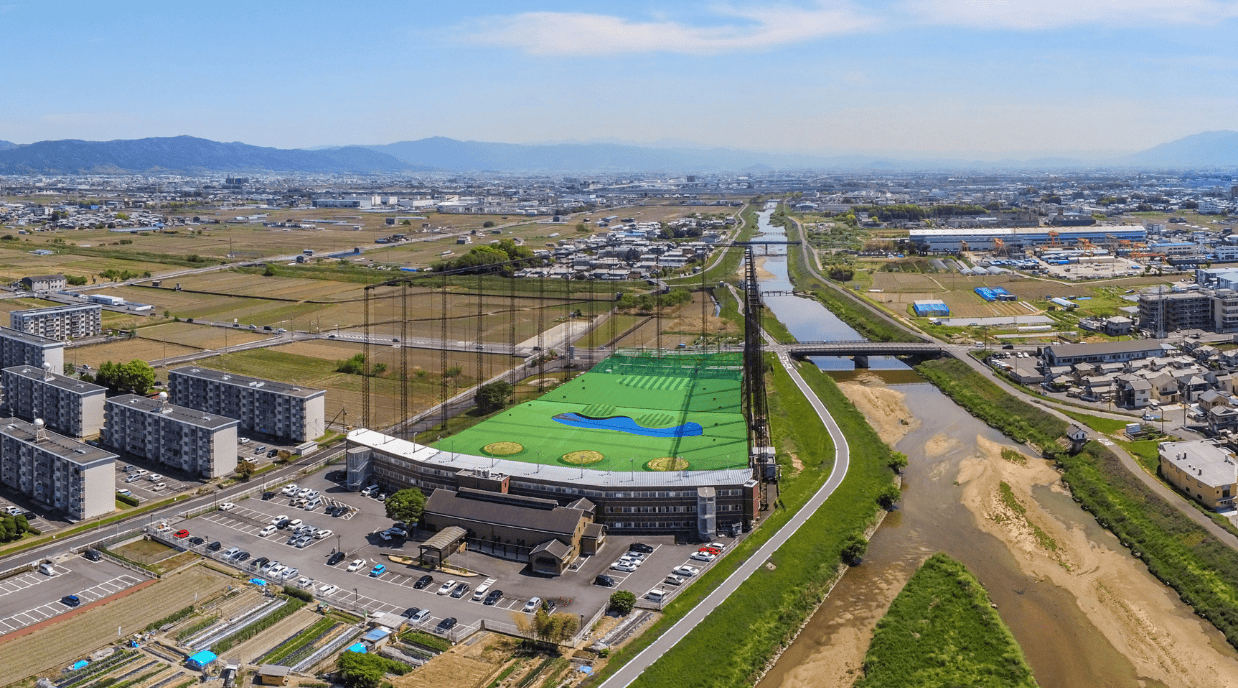
Urban Golf Driving Range Nets: What Facility Operators Need to Know
A driving range in the middle of a city is not just a golf facility. It is a neighbour.
It sits beside residential streets, parking lots, townhouses, and pedestrian paths. It operates daily, at full volume, with golf balls leaving the tee line at speeds that do not slow down just because the property line is close. And unlike a rural range with open land in every direction, it does not have the luxury of distance as a buffer.
That reality changes everything about how a driving range containment system needs to be designed, specified, and installed. Yet most of the guidance available to facility operators, and most of the netting products on the market, was built with rural facilities in mind. The result is a significant gap between what urban ranges need and what they are often given.
Key Takeaways:
- Urban ranges need site-specific engineering, not catalogue solutions. The proximity of neighbouring roads, homes, and parking lots changes every design variable — from pole height to net tension to foundation depth.
- Freestanding poles are the right structural choice for urban sites. They carry their own load, require no external anchors, and can be placed exactly where the site demands.
- How your system looks to the community matters. A clean visual profile simplifies municipal permitting, reduces neighbour friction, and protects your long-term operating relationship with the city.
- The cost of getting it wrong is operational, not just structural. Property damage, community complaints, and liability exposure are all downstream consequences of a system that was never designed for its actual site.
- The right questions separate genuine urban netting partners from general suppliers. Site assessments, engineered drawings, and references from comparable projects are the baseline, not the exception.
Why Urban Driving Ranges Are a Different Engineering Problem
Here is something most facility operators only discover once the phones start ringing from unhappy neighbours: the engineering that works perfectly on a rural range can be completely wrong for an urban one.
It is not about the quality of the materials. It is not about the experience of the installer. It is about the fact that a driving range surrounded by open land and a driving range sitting beside a residential street are two entirely different engineering problems, and they need two entirely different solutions.
When a range has open land on all sides, a stray ball that clears the netting is an inconvenience. It lands in a field, rolls into a ditch, and nobody thinks twice. But when that same range sits beside a parking lot, a busy intersection, or a row of townhouses, that stray ball has somewhere dangerous to go. The buffer is gone. The margin for error is gone with it.
The way people play golf is changing. More than 100 million adults and juniors across The R&A’s (the governing body of world golf) affiliated markets now participate in golf in some form, with driving ranges and simulators helping fuel that growth. More facilities, in tighter spaces, serving more people. And in cities around the world, those facilities are not sitting on open land anymore. The neighbourhoods are right there.
So why are so many urban ranges still being specified with systems designed for open fields?
That closeness changes everything about how a containment system needs to be designed and built. A rural range can afford a certain margin of error because the land itself acts as a buffer. Urban ranges do not have that luxury. The property line and the community boundary are often the same line. Which means the netting system has to be engineered specifically for that reality, not selected from a product catalogue that was never designed with a busy intersection fifty feet (15 metres) away in mind.
Which is why the question for an urban facility operator is never just “what netting do I need?” It is “what is on the other side of my boundary, and what does my system need to do to make sure nothing ever reaches it?”
Those are two very different starting points, and the answer to the second one is what separates a containment system that genuinely protects the surrounding community from one that just looks like it does.
Expert Field Note: Before a single pole gets specified, walk your full property boundary with someone who understands containment engineering. Measure the distance from your tee line to every adjacent road, structure, and pedestrian area. That site reality (not a standard spec shee) is what should drive every design decision that follows.
If your driving range sits beside a road, a parking lot, or a residential property, your containment system needs to be designed for that specific reality. Book a free site assessment with the Netex team and we will tell you exactly what your boundary conditions require, before a single pole gets specified.
What an Engineered Containment System Actually Looks Like
Most people hear the word “engineered” and assume it just means well-built. In the netting world, it means something much more specific, and the difference matters a great deal when the road on the other side of your boundary line is forty feet (12 metres) away.
When we assess an urban driving range site, we are not looking at a product catalogue. We are looking at the site itself. The distance from the tee line to every adjacent boundary. The height a ball needs to be caught at, given the trajectory of a full driver swing at that specific depth. The wind loads the structure needs to withstand under the site’s local conditions. The soil conditions that will determine how deep a pole foundation needs to go. Every one of those variables is specific to that site, and every one of them shapes the system we design.
Think of it like a tailor versus a clothing rack. A clothing rack gives you something that fits most people adequately. A tailor measures you specifically and builds something that fits you exactly. For a driving range beside a residential street, “adequate” is not good enough.
That process is what separates an engineered system from a commodity one. A commodity netting solution starts with the product and works outward. An engineered system starts with the site and works inward. One is a catalogue decision. The other is a design process.
The two components that matter most in an urban context are the poles and the net, and how they work together as a single structural system.
Freestanding poles are the right structural choice for urban sites because they do not rely on anything outside your property to stay upright. No cables crossing boundary lines. No shared load paths with a neighbouring fence or building. No guy-wires eating into the usable land along your perimeter.
The pole carries its own load, which means it can be placed exactly where the site requires it — right on the boundary line if that is what the containment geometry demands. In practice, that means systems reaching up to 200 feet (61 metres) high, with standard spans of up to 82 feet (25 metres) between poles — and up to 115 feet (35 metres) for custom configurations where the site demands it.
Pole height is not a standard number we pull from a chart. It is calculated from the tee-to-boundary distance, the expected ball trajectory at that distance, and the applicable wind-load requirements for that location. Get that calculation wrong by even a few feet in an urban environment and you have a system that looks complete but does not actually contain the risk.
The net itself plays an equally important role. A heavy, high-drag netting material puts more structural load on the poles and requires them to be spaced closer together, which increases cost and visual clutter. A lightweight, high-strength material like #6 Dyneema reduces wind drag significantly, which allows wider spans between poles and a lighter overall structure.
In a dense urban site where every foot of boundary line matters, that difference is not a minor specification detail. It is a meaningful design advantage.
Expert Field Note: When evaluating a proposal for an urban site, ask for the engineering drawings, not just product specs. A legitimate engineered system should include site-specific load calculations that establish the required pole embedment or piling depths. Data from wind-tunnel-tested Dyneema netting helps engineers calculate the load on each foundation based on the site’s wind zone, pole height, and span. Without those calculations, the system has been estimated, not engineered.
The Neighbourhood Factor: Why Urban Netting Has to Work From Both Sides
Here is something that does not show up on a spec sheet: the moment a neighbour decides your facility is a problem.
It rarely starts with a stray ball. It starts with a permit hearing where someone raises concerns about a towering structure on the property line. Or a city councillor who gets a call about a web of industrial cables visible from the street. Or a resident who photographs your installation and posts it to a community Facebook group with the caption “does anyone know what they are building over there?”
In an urban driving range context, your netting system has two audiences. The first is the engineering team that needs it to perform. The second is the community that has to look at it every day, and whose comfort with your facility directly affects your relationship with the city, your permitting process, and your long-term licence to operate.
Those two audiences are not in conflict. But you have to design for both of them.
A freestanding pole system with lightweight, low-drag netting does something a traditional guy-wire installation cannot. It disappears into the background.
Tapered steel poles have a clean, minimal profile against the skyline. Without the sprawling web of cables and ground anchors that traditional systems require, there is nothing cluttering the boundary line, nothing crossing onto adjacent properties, and nothing that reads as industrial or temporary to someone looking at it from the street.
That visual simplicity has real practical value. A clean pole profile is a much easier conversation at a municipal planning meeting than a sprawling anchor footprint that requires explaining. With neighbours worrying about structures blocking their views and city engineers wanting proof the installation will hold up to local weather conditions, a system that looks considered and permanent from the street addresses both concerns before anyone has to ask.
This matters beyond the initial permit. Urban facilities live and die by their relationship with the surrounding neighbourhood. A range that generates ongoing visual complaints creates ongoing friction with residents, with city staff, and with the councillors who ultimately decide whether your operating licence gets renewed without conditions. Getting the visual profile right from the start is not an aesthetic choice. It is a risk management decision.
Expert Field Note: When you are preparing for a municipal planning submission, include rendered visuals of your netting system from street level, not just engineering drawings from above. Showing the planning board exactly what the installation will look like from the neighbouring sidewalk answers the community concern before it becomes an objection.
The Liability Equation — What Urban Facility Operators Need to Understand
There is a version of this conversation that happens before an incident. And there is a version that happens after one. The difference between the two is usually an engineered containment system.
When a stray ball clears your perimeter and damages a neighbouring car, cracks a fence, or injures someone on the street outside, the conversation that follows is never comfortable. And in a densely populated area, where your boundary line is also someone else’s front yard or daily commute, the margin between a well-designed system and an inadequate one is the margin between a facility that operates with confidence and one that is managing complaints, claims, and community friction on a regular basis.
Legal requirements and liability standards vary by jurisdiction. What remains consistent is the need for facility operators to take reasonable, documented measures to prevent errant balls from reaching neighbouring properties. In an urban context, that means using a containment system designed for the specific conditions of the site. But liability is not the main reason to invest in proper engineering. The main reason is simpler: it is the right way to run a facility that sits inside a community.
Key Takeaway: The question is not whether your facility could face a liability claim. The question is whether your system was designed to demonstrate that you took the risk seriously before one ever arose.
A properly engineered containment system addresses all of these not by eliminating every possible risk — no system can promise that — but by demonstrating that the facility took the risk seriously and responded to it with a design process that was specific to the site. That documented, professional approach is what gives a facility operator something concrete to point to; evidence that the system was designed for the site, not just installed on it.
Expert Field Note: Keep your installation documentation on file: engineered drawings, load calculations, pole specifications, and installer credentials. Not because you expect to need it, but because having it means you have already answered the most important question a neighbour, an insurer, or a city inspector might ask: did you take this seriously from the start?
What to Look for in an Urban Netting Partner
Not every netting supplier is equipped to handle an urban site, and that difference rarely shows up in the sales conversation. It shows up on the day of installation, or the day something goes wrong. The right partner understands the full scope of what an urban containment system requires, from the initial site assessment through to the final installation, and has the experience and documentation to back it up.
Before you commit to a supplier, these are the questions worth asking:
- Do they conduct a formal site assessment before specifying anything? A supplier who quotes you a system without walking your property boundary first is quoting you a generic solution, not an engineered one.
- Can they provide engineered drawings and load calculations? These should be specific to your site, not standard templates pulled from a previous project.
- Do they supply and install the pole system themselves? True accountability only exists when the company designing the system is the same one pouring the concrete and erecting the poles.
- Do they have documented experience with urban or high-proximity sites in comparable conditions? Wind zones, soil conditions, building codes, and municipal permitting processes vary by location. Experience designing for the conditions and requirements of the project’s jurisdiction matters.
- Do they understand local zoning and building permit requirements? In an urban context, the permit process is part of the project. A supplier who has never navigated it is going to slow you down.
None of these questions are unreasonable. A supplier with genuine urban experience will answer all of them without hesitation. The ones who cannot are telling you something important, and it is better to find that out before the poles go in the ground than after.
At Netex, we have been designing and installing engineered netting systems for golf and sports facilities across Canada, the United States, Australia, and Korea for over four decades. The urban containment projects in our portfolio range from municipal recreation centres to high-density mixed-use developments — each one assessed, engineered, and installed by our own team, not subcontracted. That experience is what the questions above are designed to help you find in any supplier you evaluate, including us.
Conclusion: Build It for the Community Around It
Every section of this article comes back to the same point: an urban driving range containment system is not a product decision. It is a design decision, one that starts with the specific site, the specific boundary conditions, and the specific community that surrounds the facility every day it is open.
Getting that right means working with a partner who assesses the site before specifying anything, engineers the system for the actual loads and constraints of that location, installs everything in-house, and stands behind the result. It means choosing a pole system that performs structurally and sits cleanly in the neighbourhood. And it means understanding that the driving range barrier netting around your range is not just protecting your facility; it is protecting the street, the parking lot, and the homes on the other side of your boundary line.
The right system starts with the right conversation. Request a site assessment from Netex — we will walk your boundary and tell you exactly what your site needs.
About the Author
Mark Wilson is the founder of Netex Netting (Netex Canada Netting Inc.), a global leader in golf and baseball netting systems. With 47+ years of net-building expertise, he pioneered low-drag Dyneema® golf nets and designed integrated pole, lighting, and turf solutions. He also developed the Dyneema® #15 which is the thinnest-diameter, lowest-wind-drag twine used on backstop safety nets at every MLB park today – and earned certified wind tunnel test approvals, along with the first-ever certified burst and break strength testing for a baseball backstop net. Netex delivers precision installations worldwide and stands behind them with industry-leading warranties.
Frequently Asked Questions
How high does a driving range net need to be for an urban site?
There is no universal answer, and that is exactly the point. Height is calculated based on the distance from your tee line to the boundary, the expected ball trajectory at that distance, and local wind load requirements. For urban sites, that calculation is non-negotiable. Our engineered golf barrier systems can reach up to 200 feet (61 metres) high, but the right height for your site depends entirely on your specific boundary conditions.
What is the difference between a freestanding pole and a guyed pole system?
A freestanding pole carries its own structural load without external cables or ground anchors. A guyed system uses cables extending outward from the pole base to distribute that load — which means it requires more land, more hardware, and in an urban context, cables that can cross boundary lines onto neighbouring properties. For urban sites, freestanding is almost always the right choice. You can learn more about how we engineer our pole systems here.
How long does a driving range netting system last?
Our #6 Dyneema golf barrier netting has a projected life expectancy of more than 25 years, backed by a 15-year limited warranty against UV degradation and a 2-year workmanship warranty. Longevity depends heavily on material quality, installation precision, and how well the system was engineered for its specific site loads.
Do I need a building permit to install driving range nets ?
Permit requirements for structural pole installations vary by country, region, and municipality, so there is no single answer that applies everywhere. What is consistent is this: if your installation involves engineered structural poles and foundations—whether direct embedment, concrete foundations, or piling—you should contact the appropriate local building authority early in the planning process. A netting partner with experience working across multiple jurisdictions can help coordinate with local engineers and permitting authorities before the process becomes a delay.
What is Dyneema and why does it matter for urban driving range netting?
Dyneema is the world’s strongest fibre by weight, up to 15 times stronger than steel. For urban netting applications, its low weight and minimal wind drag are what matter most. Less drag means less structural load on the poles, which allows wider spans, fewer poles, and a cleaner visual profile. Netex pioneered the use of Dyneema in golf barrier netting, and our #6 Dyneema golf barrier net offers an abrasion life four times longer than generic alternatives, with a projected lifespan of more than 25 years.